This article is brought to you by Junior Achievement USA.
As the nation’s leading experiential learning provider dedicated to accelerating economic mobility, Junior Achievement views AI as a challenge and an opportunity for this and future generations. Experts predict AI may eliminate as many as 300 million jobs (or possibly more) globally in the coming years, while also being used to augment many more occupations. But unlike coding, which requires the learning of hard skills to effectively navigate, AI has a low barrier of entry in the skills sense, but over time - due to challenges with reliability, security, scalability, and human-first skills like ethics - ultimately depends on people’s durable skills such as critical and creative thinking, problem solving, and continuous learning to manage effectively. These are the same indelible skills promoted by Junior Achievement to accelerate economic mobility. The greatest strength JA brings to the AI conversation isn’t simply how to work with AI, but how to succeed in a world being reshaped by AI.
This subject is top of mind for education leaders. According to a March 2026 of these leaders (superintendents, chief academic officers, curriculum directors) by Basinait Insights on behalf of Junior Achievement, 73 percent believe it is very or extremely important for education partners working with them to teach human advantage skills (critical and creative thinking, problem-solving, etc.), alongside AI literacy skills. Additionally, 93 percent believe it is very or extremely important to emphasize the ethical use of AI among students. Additionally, 93 percent believe it is important for such organizations to emphasize the ethical use of AI among students.
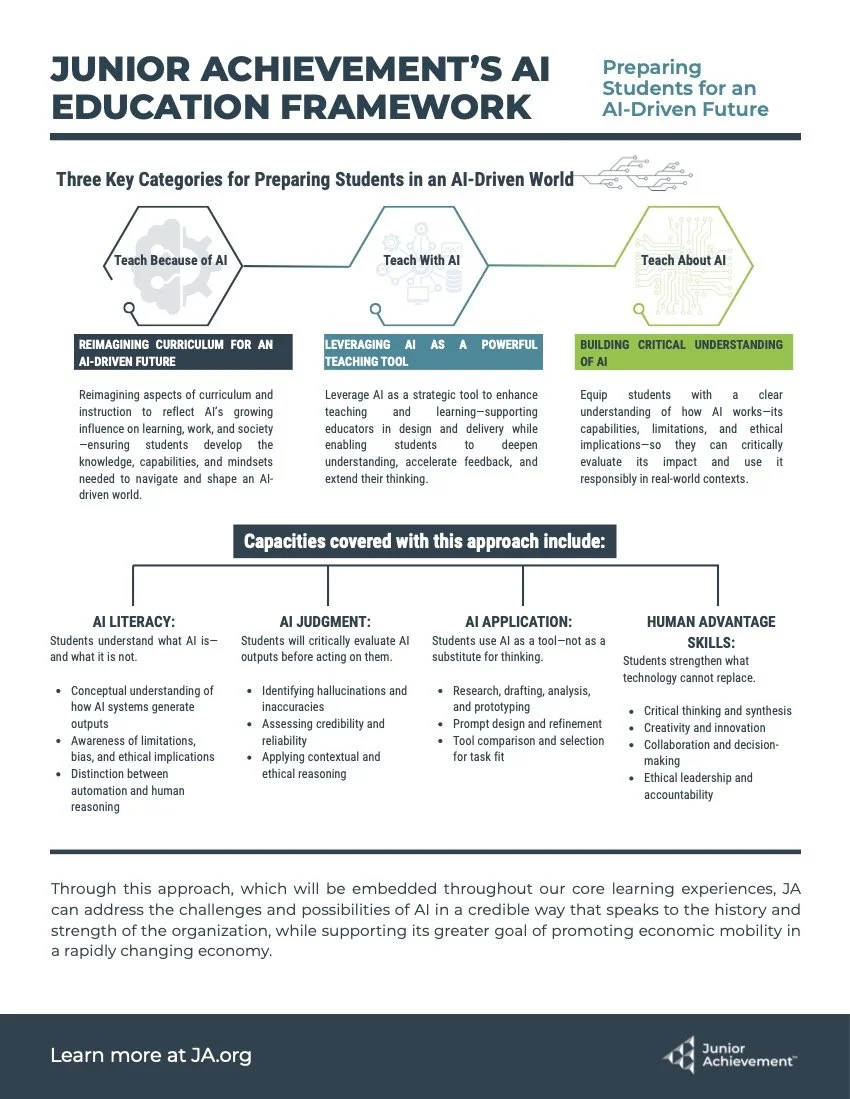
It’s necessary to think of JA’s approach to AI from two perspectives: primarily as a touchpoint of our purpose, given our mission, and secondarily as a functional necessity, as a resource-constrained nonprofit. For the latter, JA sees AI as a powerful force-multiplying tool and has begun adopting AI resources in the development of our learning experiences, marketing efforts, and IT support structures. But for the former, it’s imperative that we educate today’s students that working with AI doesn’t begin and end with a prompt.